untitled, 2025
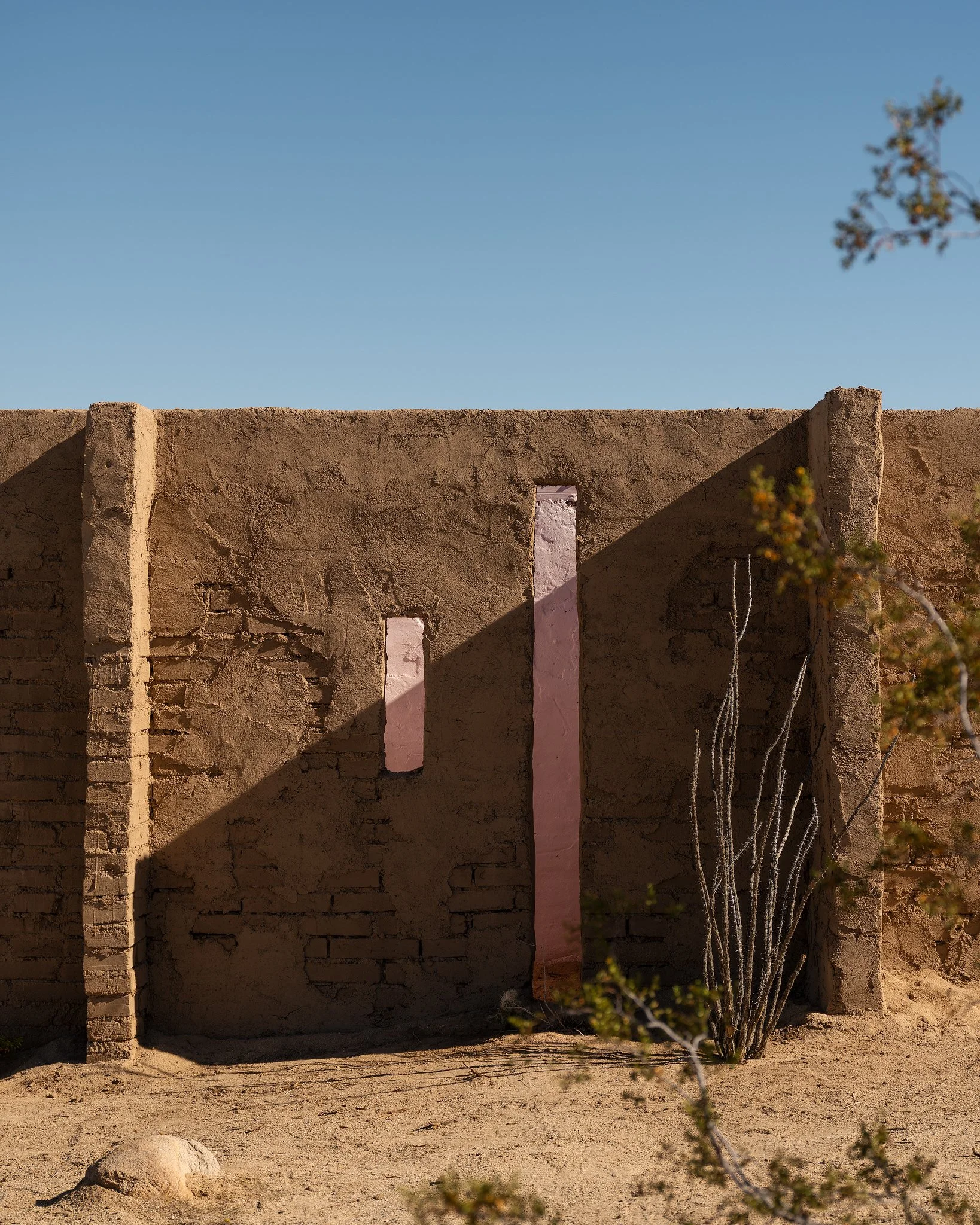
Untitled
Untitled is a site-responsive adobe structure conceived by William Morgan for the 2025 edition of the Joshua Treenial, constructed in the grid form of the “#” symbol—variously known as the pound sign, number sign, or hashtag. Simultaneously architectural, symbolic, and conceptual, the work emerges from an extended inquiry into landscape, erasure, materiality, and ecological mutualism.
Formed by hand from sun-dried adobe bricks, the structure sits low on the desert floor—not as monument or shelter, but as what philosopher Michael Marder might describe as a vegetal gesture: a porous, time-bound configuration that resists fixity and instrumentalization. Where permanence once signaled authority, here, erosion is ethics. The symbol becomes material. The structure becomes question.
The grid’s form—one of the most persistent visual grammars across civilizations—is here translated from digital metadata into earth-based construction. As communication accelerates toward abstraction, this act becomes a temporal inversion: a slowing of networks, a thickening of space, a refusal of instantaneity. In a gesture resonant with Kevin Munger’s critique of digitally synchronized publics, the work unlinks the symbol from its algorithmic circulation and instead binds it to geological rhythm. The “hashtag,” stripped of its feed, becomes adobe: a non-viral marker of relation.
Rooted in the visual logic of the nine-square grid—from Palladian proportion to modernist reduction—the form carries historical architectural lineage while proposing an alternate ethic of building. Unlike the sleek permanence of desert modernism’s steel and glass, Untitled draws from ancient material logics that welcome erosion and embed decay into their design. The sculpture listens to the slow violence of sun, dust, and rain—forces that Flusser might call the post-historical image: matter reorganized not by mastery, but by exposure.
Flusser’s writing on the apparatus and functionary finds uncanny resonance here: the digital sign (#) becomes unplugged from its device, rendered into soil, disconnected from its instrumentality. It becomes not function, but field—a zone of contact, not control. Adobe, in this sense, is a form of unlearning: not output, but residue.
At the center of the work is a conceptual re-reading of Jean Siméon Chardin’s Soap Bubbles (1733–34), wherein the suspended bubble becomes both a vanishing point and a meditative surface for projection. The boy, absorbed in the fragility of the moment, watches something that will not last—yet is no less real for its disappearance. That is this work’s philosophical key: not transcendence, but ephemeral presence. Not message, but atmosphere.
As in Chardin’s painting, the adobe structure situates itself in fragile balance between interior and exterior, form and void, stillness and weather. Its apertures function as metaphysical gaps—what Marder names “sites of plant-thinking”: generative, relational, and ungovernable. These openings do not frame the view—they unframe it, drawing the viewer into the rhythm of ecological time.
Suspended within the structure are devices of weight, measure, and ambiguous utility—objects that suggest neither ritual nor data, but a refusal of legibility. In this, the piece echoes Anthony Elms’ curatorial approach to non-linear meaning: where objects do not serve narrative, but destabilize it. They are proposals without explanation, metaphors without anchors. They do not speak, but hum.
The adobe form also enacts a critique of dominant environmental imaginaries in the American Southwest—where “sustainability” often remains tethered to technological solutions rather than embodied traditions. In contrast, this work draws from indigenous building histories, permacultural cycles, and vegetal intelligence. Its survival depends not on innovation, but attunement.
What Marder proposes—through the vegetal—is not a return to nature, but a refusal to separate thought from growth, decay from intelligence. To build with adobe, here, is not nostalgia—it is epistemology. A way of knowing through slowness. A way of remembering through matter. A way of designing that does not fear dissolution.
The desert, in this framework, is not a setting, but a collaborator. Its ecology enters the work through wind, insects, animal tracks, and silence. Its conditions shape the drying, cracking, settling, and eventual crumbling of the form. There is no preservation plan. There is only participation.
To inhabit the work is not to enter, but to be held loosely. There are no doors. No boundaries. The symbol resists enclosure because the future it imagines is not secured by walls, but made possible by permeability. In this way, the work becomes less sculpture than thinking environment—an unprogrammed interface for staying with uncertainty.
With Untitled, William Morgan contributes to evolving conversations around architecture, philosophy, and posthuman design. It gestures beyond monumentality and instead toward symbiotic entanglement. It does not illustrate theory, but metabolizes it.
It asks:
What can be built from memory and erosion?
What happens when vegetal life becomes the model for form?
What if architecture no longer promises safety, but practices exposure?
This is not a work that lasts forever. It is a work that leaves behind a texture of thought – a vegetal timekeeper.
Resources:
Flusser, Vilém. Into the Universe of Technical Images. Translated by Nancy Ann Roth. Minneapolis: University of Minnesota Press, 2011.
Flusser, Vilém. Writings. Edited by Andreas Ströhl, translated by Erik Eisel. Minneapolis: University of Minnesota Press, 2002.
Marder, Michael. Plant‑Thinking: A Philosophy of Vegetal Life. New York: Columbia University Press, 2013.
Marder, Michael. Plants in Place: A Phenomenology of the Vegetal. New York: Columbia University Press, 2024.
Munger, Kevin. Generation Gap: Why the Baby Boomers Still Dominate American Politics and Culture. New York: Columbia University Press, 2022.